

40 metres decided this development

Four seasons, 20th oct) Walking Distance Matters: Key Housing SEPP Decision Clarifies Low and Mid-Rise Eligibility
On 30 September 2026, the NSW Land and Environment Court handed down an important decision for councils, developers and planning practitioners on the meaning of "walking distance" under the Low and Mid-Rise Housing provisions of the State Environmental Planning Policy (Housing) 2021 (“Housing SEPP”).
In Metis Developments Pty Ltd v Mosman Municipal Council [2026] NSWLEC 1610, the Court considered a seemingly simple question that ultimately determined whether a development site qualified for the more permissive development standards available within the Low and Mid-Rise Housing "inner area".
As solicitors for Mosman Council, Marsdens successfully defended the Council's interpretation of the Housing SEPP.
The Dispute
The Housing SEPP defines "walking distance" as:
"the shortest distance between 2 points measured along a route that may be safely walked by a pedestrian using, as far as reasonably practicable, public footpaths and pedestrian crossings".
The development site's eligibility depended on whether it was located within 400 metres walking distance of the Mosman Town Centre.
The parties agreed on the start and end points, but disagreed about the route that should be used.
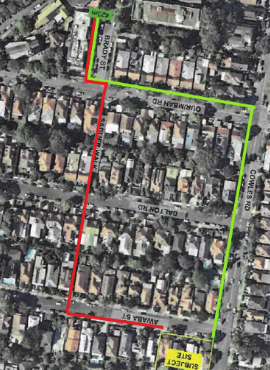
Figure 1: Applicant’s walking route (red) and Council’s walking route (green)
The applicant relied on a route measuring approximately 383 metres that crossed busy Ourimbah Road at the Brady Street intersection without using a formal pedestrian crossing. Mosman Council contended that pedestrians should instead use the nearby signalised crossing at the Ourimbah Road and Cowles Road intersection, resulting in a route of approximately 423 metres.

Figure 2:Applicant’s crossing at Ourimbah Road/Brady Street intersection (left) NS Council’s crossing at Ourimbah Road/Cowles Road signalised intersection (right)
The difference was only around 40 metres, but it was enough to determine whether the site fell inside or outside the Housing SEPP's inner area.
What Did the Court Decide?
Commissioner Targett accepted Council's position.
The Court found that the definition of "walking distance" must be read as a whole. The requirement to use public footpaths and pedestrian crossings, where reasonably practicable, is not an optional consideration that applies after identifying the shortest route. Rather, it forms part of the process of selecting the route itself.
In practical terms, this means that when determining walking distance under the Housing SEPP, a route cannot simply be chosen because it is shorter if it ignores a reasonably practicable pedestrian crossing.
In this case, the Court considered the use of the pedestrian crossing at the lights at the intersection of Cowles Road and Ourimbah Road was reasonably practicable, particularly given its positioning with reference to the site and when considering that Ourimbah Road is a classified regional road regularly carrying volumes of up to 1,000 vehicles per hour.
The Court therefore preferred the Council's route using the signalised crossing on Ourimbah Road. As a result, the site was located outside the 400-metre inner area and the development application could not be approved in circumstances where the application did not comply with the “inner area” development standards identified in the Housing SEPP.
Why Is This Decision Important?
The decision is one of the first detailed judicial considerations of the Housing SEPP's walking distance provisions and provides valuable guidance for future development assessments.
The case confirms that:
- walking distance assessments must consider safe pedestrian movement;
- available pedestrian crossings cannot be disregarded merely because they add extra distance;
- the statutory definition should be applied according to its ordinary meaning; and
- relatively small differences in route selection can have significant planning consequences.
Marsdens acted for Mosman Municipal Council in these proceedings. Our Local Government, Planning and Environment team regularly advises councils, developers and landowners on the operation of the Housing SEPP and planning appeals in the Land and Environment Court.
Phone: (02) 4626 5077
This publication is for general reference only and does not constitute legal advice. Specific legal advice should always be sought before taking any action based on this article.
Want to hear more from us?
Subscribe to our mailing list
